Data centers are critical in providing the computing and storage infrastructure needed to not only power the internet but also connect communities all over the world.
Updated on 18/08/2026.
To become greener and more efficient, data centers are actively looking for ways to reduce their energy usage, offset their carbon footprints, reduce water utilization, and decrease the materials used within them.
However, there are other (and perhaps less obvious) ways in which data centers can become greener and improve their sustainability credentials.
Contents
- What is the environmental impact of the data center industry?
- How can data centers operate more sustainably?
- Green energy and battery recycling
- Decommissioning and ITAD services for data cent.
What is data center sustainability?
Data center sustainability is the practice of reducing the environmental impact of data centers through energy efficiency, renewable energy adoption, responsible hardware management, battery recycling, and circular IT asset disposition (ITAD). Sustainable data centers lower carbon emissions, reduce waste, and support long-term environmental goals while maintaining reliable operations.
What is the environmental impact of the data center industry?
The number of large data centers operated by hyperscale companies recently passed the 1,000 milestone, accounting for 41% of the worldwide capacity of all data centers. This is expected to grow to over 60% by 2029, with an additional 120-130 hyperscale data centers coming online each year.
These data centers consume significant energy, not just for powering servers but also for cooling systems, with usage often exceeding that of small countries. The demand for more and larger data centers continues to grow due to trends such as cloud computing, AI, and streaming services.
The Climate Neutral Data Centre Pact aims to ensure that data centers adopt sustainable practices, contributing to a greener future.
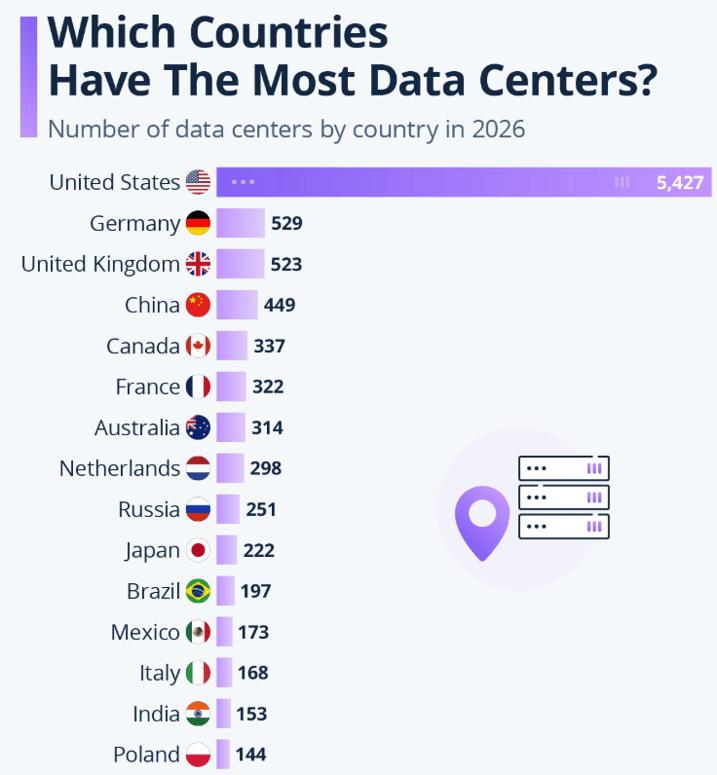
Image Source: Statista - Which countries have the most data centers?
How can data centers operate more sustainably?
With the right design, building, and operating strategies, data centers can become sustainable infrastructure for a green future. Key approaches include reducing energy consumption, adopting clean energy sources, and improving efficiency and data security through hardware decommissioning.
Data centers can improve sustainability by:
- Using renewable energy sources.
- Deploying battery energy storage systems.
- Improving cooling efficiency.
- Recycling lithium-ion batteries.
- Extending the life of IT equipment through reuse.
- Partnering with certified ITAD providers.
- Responsibly recycling end-of-life IT infrastructure.
We will go into each of these in more detail below.
Green Energy and Battery Recycling
Improving efficiency and adopting renewable energy sources are essential for reducing a data center’s carbon footprint. Despite efforts, many operators still rely on diesel generators for backup power. An alternative is battery energy storage solutions (BESS), which can store and discharge renewable energy as needed. BESS systems can even utilize second-life electric vehicle batteries, providing a greener alternative to diesel generators.
Companies like Google are committing to operating on 24/7 carbon-free energy by 2030, using solutions like BESS to overcome challenges related to renewable energy intermittency.
Lithium-ion batteries in uninterruptible power supplies (UPS) offer longer lifespans and better performance but rely on scarce raw materials. Innovative recycling processes can recover valuable elements like graphite, cobalt, and lithium for reuse. SK Tes provides recycling services for lithium-ion batteries from UPS hardware, promoting a circular economy.
Decommissioning and ITAD services for Data Centers
As AI adoption continues to grow, the sustainability of digital infrastructure will depend not only on energy efficiency and decarbonization but also on how effectively hardware is managed across its lifecycle. In this context, our role is to enable a more circular approach to technology, ensuring that the systems powering the digital economy are supported by resource-efficient and responsible end-of-life solutions.
Data centers can embed circular thinking by partnering with IT asset disposition (ITAD) services. Decommissioned hardware can be securely sanitized and remarketed or recycled to reduce e-waste, adhering to standards like NIST 800-88, IEEE and R2.
Why Is ITAD Important for Sustainable Data Centers?
IT asset disposition (ITAD) for data centers reduce e-waste by securely sanitizing, refurbishing, remarketing, and recycling retired IT equipment. By extending the lifecycle of IT assets, organizations can reduce landfill waste, recover value, and support circular economy objectives.
Data center services reduce e-waste during decommissioning by prioritizing recovery over disposal. They do this by identifying reusable equipment, extending asset life through redeployment or remarketing, recovering valuable components, and recycling only what cannot be reused. Secure data destruction, staged refresh planning, and compliant handling also help prevent unnecessary waste. In short, the process follows a clear hierarchy: reuse first, recover parts next, and recycle responsibly as a last step.
The best data center disposition services for sustainability goals are usually the ones that emphasize reuse first, certified downstream recycling second, and measurable reporting throughout. Opt for a trusted provider that prioritize asset remarketing and reuse, provides certified data erasure and chain of custody, comprehensive environmental reporting, adheres to relevant recognized certifications ISO 14001, NIST and IEEE and can showcase data center equipment expertise.
Why choose SK Tes as data center service provider?
SK Tes supports leading hyperscale and enterprise data centers with data center decommissioning services and sustainable lifecycle technology solutions, achieving over $4.9 million in IT asset remarketing value. Learn more in our case study.
Another client of SK Tes, INEOS Grangemouth, in the UK, achieved 35,660kg CO²e carbon emissions savings generated through reuse and recycling over 3000 assets as part of their ITAD program. Read on to find out how SK Tes helped INEOS Grangemouth clear redundant IT hardware safely, sustainably and securely.
Download our Sustainability Report to explore our goals, including reducing energy consumption, mitigating GHG emissions, and promoting a zero-waste-to-landfill commitment.
This reflects our commitment to transforming 1 billion kg of assets securely and sustainably by 2030.
Conclusion