Nearly half of companies fail to meet their sustainability targets, not because they lack ambition, but because ESG often feels disconnected from daily work. According to the World Economic Forum, the biggest barrier isn’t policy or reporting, it’s employee engagement.
Despite ambitious ESG commitments, many global organisations struggle to turn intent into impact. The challenge isn’t a lack of frameworks or reporting systems; it’s the disconnect between strategy and everyday work. True leadership means going beyond target setting and embedding ESG principles into operations so that every decision drives measurable change.
This blog explores how organizations can move from simply setting ESG (Environmental, Social, and Governance) targets to truly embedding ESG principles into everyday operations. It highlights the importance of employee engagement, the shift from compliance to competitive advantage, and the critical role of data and communication in driving measurable ESG progress. The blog draws on industry insights and practical examples to show how every employee can contribute to sustainability goals, making ESG a core part of organisational culture rather than a separate initiative.
- Raising the Bar: From Compliance to Competitive Advantage
- The Human Factor: Why Engagement Matters
- Data That Drives Action
- Creating Conditions for Contribution
- Why It Matters
Raising the Bar: From Compliance to Competitive Advantage
Industry leaders don’t stop at meeting minimum standards. They go beyond, embedding ESG into the fabric of their operations. That means:
- Ethical Supply Chains: Ensuring responsible sourcing and labour practices across global networks.
- Carbon Reduction: Cleaner logistics, energy-efficient facilities, and optimised transportation.
- Diversity & Inclusion: Building teams that reflect the communities we serve.
- Circular Economy Leadership: Increasing recovery rates for IT devices and batteries, reducing e-waste globally.
These are what distinguish leaders from competitors. In ITAD, clients choose partners who can prove measurable reductions in environmental impact, higher resource recovery rates, and stronger data security. ESG performance isn’t just a moral imperative - it’s a business advantage.
The Human Factor: Why Engagement Matters
Policies and dashboards don’t drive progress - people do. Engagement happens when employees see how their work connects to ESG outcomes. In our industry, that connection is tangible:
- Operations teams repurposing technology and extending its lifecycle reduces the emissions associated with producing new equipment.
- Sales teams educating clients on certified disposal aren’t just closing deals, they’re preventing devices from ending up in unsafe facilities.
- QEHS representatives catching compliance issues aren’t just ticking boxes - they’re protecting certifications that enable global market access.
Every role has ESG implications. When employees understand this, ESG stops being a program or initiative and becomes part of how the organisation thinks and operates.
Data That Drives Action
For ESG to genuinely drive progress, it has to function as more than a reporting requirement. The data we collect only becomes valuable when it informs decisions and supports improvements. Reporting becomes meaningful when it reveals where we can do better, and targets become achievable when employees understand how their work contributes to outcomes that matter.
Many companies collect ESG data but fail to connect it to strategy. At SK tes, our goal is to close that gap. Reporting is the evidence that proves impact and informs decisions. When we track e-waste diversion or carbon avoidance, we’re not just meeting targets, we’re going beyond and creating a feedback loop. Data informs strategy which drives action and generates better data. The cycle turns ESG from a reporting exercise into a growth driver.
"Raising the bar isn’t about adding new tasks; it’s about making the impact of our work more intentional. When people understand how their decisions influence recovery rates, carbon reduction, ethical sourcing, or workplace inclusion, ESG becomes part of how the organisation thinks and operates - not a separate initiative."
Sofia Peruzzo, Group ESG Manager, SK tes
Creating Conditions for Contribution
True ESG leadership means treating employees as contributors to strategy, not just implementers of policy. At SK tes, we’re investing in:
- Visibility: Dashboards that show how operational changes translate into measurable impact.
- Communication: An award-winning employee newsletter informing and educating our teams on ESG impact.
- Voice: Forums for sharing process improvements and sustainability ideas.
- Transparency: Honest conversations about trade-offs when environmental goals intersect with cost pressures.
Why It Matters
When clients and auditors evaluate ESG commitments, they look for evidence that sustainability thinking is embedded in problem-solving and operations. That evidence comes from employees who understand their role and actively contribute. Their work generates the data that proves impact, informs action plans, supports strategic goals, and positions us as industry leaders.
ESG success isn’t a separate initiative - it’s the story we write together, every day. Find out more about sustainability at SK tes on our website: www.sktes.com/sustainability
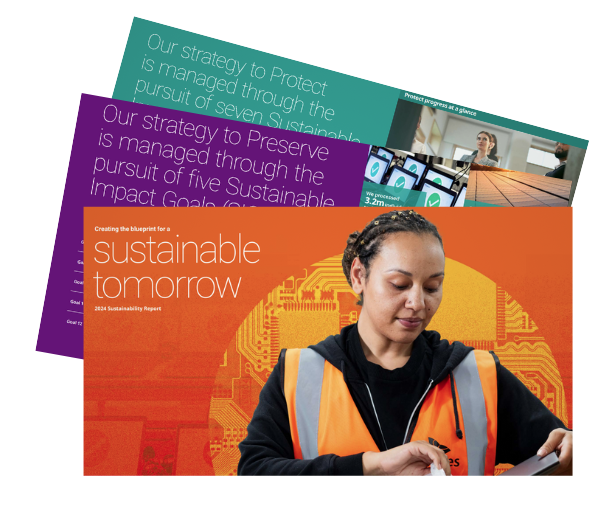
Download our latest Sustainability Report "Going Beyond"
At SK Tes, sustaining tomorrow is our foundation. Our latest verified sustainability report shows our measurable impact in climate action, circularity, and social responsibility.