Somewhere between the boardroom and the loading dock, sustainability strategy tends to get abstract. Executives talk about "nature positive" commitments and biodiversity frameworks; the people actually running IT operations are making everyday decisions about how technology is used, redeployed and eventually retired. The World Economic Forum's December 2025 report, Nature Positive: Role of the Technology Sector, is one of the first major efforts to close that gap for the tech industry specifically.
Produced with Oliver Wyman as part of the Forum's Nature Positive Transitions series, the report's premise is straightforward. Technology has a significant role to play in reversing nature loss and reducing environmental impact across its value chain, not because it's a nice-to-have, but because the sector's own growth increasingly depends on it. Semiconductor plants alone consume more than 1 trillion liters of freshwater a year. Combined with data centers, the tech sector's water draw tops 1.5 trillion liters annually, more than the entire country of Denmark uses. Global e-waste topped 62 billion kilograms in 2022, the report's most recent cited figure, with only about 22.3% documented as formally collected and recycled in an environmentally sound manner.
That leaves a practical question for anyone managing IT at scale. What does "nature positive" actually look like when your job is procuring, deploying, and eventually retiring thousands of devices, servers, and data center assets across a global footprint? The WEF report lays out the strategic case. SK tes' newly published 2025 Sustainability Report, "Resilience in the Circular Economy," is a useful place to see what putting that case into practice actually looks like.
Why Nature Loss has Become a Technology Sector Issue
The Forum's argument starts from a number that's easy to skim past. Humanity is currently using natural resources at a rate equivalent to 1.8 Earths. Monitored wildlife populations have declined by an average of 73% since 1970. More than half of global GDP is moderately or highly dependent on nature and the services it provides, and the report is blunt that most industries, tech included, have not caught up to what that means for how they operate.
Among Fortune Global 500 companies, 78% have set climate targets. Just 12% have set targets for biodiversity loss, and only 5% have even assessed their impact on nature at all. Fewer than 1% understand their dependencies on natural systems well enough to manage the risk. Tech is not exempt from that gap, and the report argues it can't afford to be. More than 1 trillion semiconductors are sold every year, over 11,000 data centers are now operational worldwide, and demand for both is accelerating as AI adoption grows. Since May 2024, roughly $64 billion in U.S. data center projects have been delayed or blocked outright over local opposition tied to competition for energy, water, and other natural resources, which the Forum frames as an early warning sign of what happens when growth outpaces resource stewardship.
The report is equally clear that resource extraction, not just carbon, is where a lot of that pressure originates. Its own materiality analysis rates land use tied to mining for the tech industry as high-impact, alongside water use and emissions from semiconductor manufacturing and data centers. Which is exactly where circularity, extending a device's life, reusing it before recycling it, and recovering materials instead of mining new ones, stops being a sustainability talking point and starts being a nature strategy.
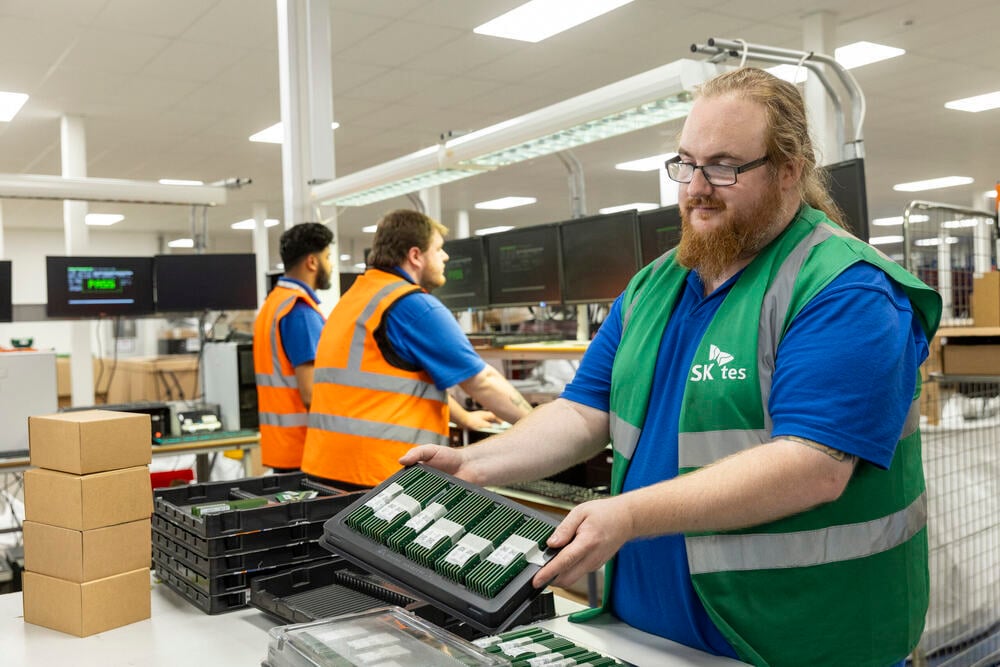
That shift already shows up in SK tes' own numbers. In 2025, the company processed 127,635 metric tons of IT and electronic assets and achieved a 99.82% overall reuse, recycling, and recovery rate, up from 97.95% the year before. Nearly 2.6 million individual devices, laptops, desktops, servers, monitors, and more, were processed specifically for reuse rather than material recovery, an outcome the report estimates helped customers avoid roughly 97,983 tons of CO2e in emissions that manufacturing replacement hardware would have generated.
The Circular Economy just Became a Nature Strategy
The Forum makes a point worth sitting with. Recycled metals can be two to ten times more energy efficient to produce than metals smelted from virgin ore. Of the roughly 31 billion kilograms of metal locked inside global e-waste in 2022, only about 60% was ever recovered, leaving approximately $62 billion in recoverable natural resources remaining unaccounted for.
Every laptop that gets reused instead of replaced, and every server that gets refurbished instead of scrapped, is demand for newly mined and manufactured material that simply doesn't happen.
SK tes’ progress illustrates how circularity can be translated into measurable action. Through its “Decade of Difference” ambition, the company aims to sustainably transform and repurpose one billion kilograms of technology assets by 2030. By the end of 2025, cumulative progress had reached 565.3 million kilograms, passing the halfway point and demonstrating the growing scale at which technology assets and their constituent materials can be kept in productive use.
On landfill diversion specifically, 2025 marked a milestone the company had been building toward for years. SK tes achieved its zero-waste-to-landfill goal, and landfill disposal plus non-energy-recovery incineration combined now account for less than 1% of total waste processed, with landfill volume falling 92% compared with 2024.* Recovered ferrous and non-ferrous metals, printed circuit board precious metals, and even critical materials like lithium and cobalt recovered from end-of-life batteries are returned to supply chains rather than mined again from the ground up, which is precisely the "reduce reliance on virgin material extraction" outcome the WEF report identifies as a priority action for the sector.
However, circularity metrics alone do not demonstrate that a company or service is nature positive. The next step is to translate these outcomes into credible nature-related indicators, such as reduced demand for virgin critical materials, water and pollution impacts, and potential pressures on land and ecosystems. SK tes is considering how its Carbon Loop Calculator could evolve beyond avoided carbon emissions to provide a more holistic assessment of the environmental and social value created through reuse and recycling.
Sustainable IT Management is no Longer Optional
It would be a mistake to read any of this as waste management with better branding. The WEF report positions the seven priority actions it recommends for tech companies, including circularity, supply chain engagement, and land stewardship, as core to how the sector protects its ability to keep growing, not as a side project bolted onto operations. Companies that get ahead of their nature-related risk, the report notes, are better positioned to manage supply chain disruption, meet the fast-rising expectations of investors and customers, and avoid the kind of local opposition that has already stalled tens of billions of dollars in data center development.
For any organization managing technology at scale, this reframes sustainable IT asset management, redeployment, decommissioning, secure data destruction and responsible disposition as part of its broader infrastructure and sustainability strategy. Although much of a device’s environmental footprint arises upstream through raw-material extraction and manufacturing, decisions made at retirement determine whether its remaining value is preserved through reuse, refurbishment and responsible material recovery.
SK tes applies this principle across the technology lifecycle, prioritizing the secure redeployment, reuse and refurbishment of assets before responsible material recovery.
As CEO Jin Mo Lee observed in the 2025 Sustainability Report, “Every additional kilogram we process represents material diverted from disposal and returned to productive use.”
Through its facilities and global partner network, SK tes helps organizations preserve the value of technology and its constituent materials while maintaining data security, regulatory compliance and responsible downstream management.
Why Nature Related Measurement and Disclosure are Growing
None of this can be managed credibly without measurement. Nature-related disclosure is following a path similar to climate reporting: beginning with voluntary frameworks such as the Taskforce on Nature-related Financial Disclosures, while increasingly influencing regulation, investor expectations, procurement requirements and customer due diligence. In the European Union, the Corporate Sustainability Reporting Directive and European Sustainability Reporting Standards also introduce nature-related disclosures for companies where topics such as biodiversity, ecosystems, water use or resource consumption are assessed as material.
SK tes’ 2025 Sustainability Report reflects this movement towards more structured and accountable disclosure. The company completed its first Double Materiality Assessment in 2025 and subjected its sustainability information and greenhouse-gas inventory to independent assurance and verification. This provides a stronger foundation for understanding not only climate-related performance, but also the wider environmental and social impacts associated with technology lifecycle management.
However, measurement of nature-related outcomes remains at an earlier stage than carbon accounting. Developing credible indicators for resource dependence, water, pollution, land and ecosystem pressures will require more detailed data and robust lifecycle methodologies. Recognizing this gap is important: transparency involves reporting what can already be measured while being equally clear about where methodologies still need to evolve.
From Global Ambition to a Warehouse Floor
Technology isn't the industry people picture first when they think about protecting nature. But the World Economic Forum's report makes a case that's hard to argue with once you see the numbers. How organizations procure, deploy, redeploy, and retire their technology has a direct, measurable effect on resource consumption, emissions, and the pressure the global economy puts on natural systems. Getting that right isn't a separate initiative from good IT asset management. It's what good IT asset management increasingly means.
SK tes’ experience shows how nature-related ambition can begin with practical decisions about how technology is managed. Extending asset life, prioritizing reuse and recovering materials responsibly can reduce pressure on virgin resources and prevent valuable materials from becoming waste. The next challenge is to measure these wider outcomes more precisely—including impacts on water, land, ecosystems and communities—so that circularity’s contribution to a nature-positive economy can be demonstrated credibly.
Zero waste to landfill means diverting at least 99% by weight of waste from landfill and non-recovery disposal routes, with less than 1% disposed where no technically feasible or legally compliant recovery alternative exists.


Related posts
Inside Data Center Decommissioning at Scale
Read more
4 Ways SK Tes Drives Social Impact With Sustainability Initiatives
Read more